
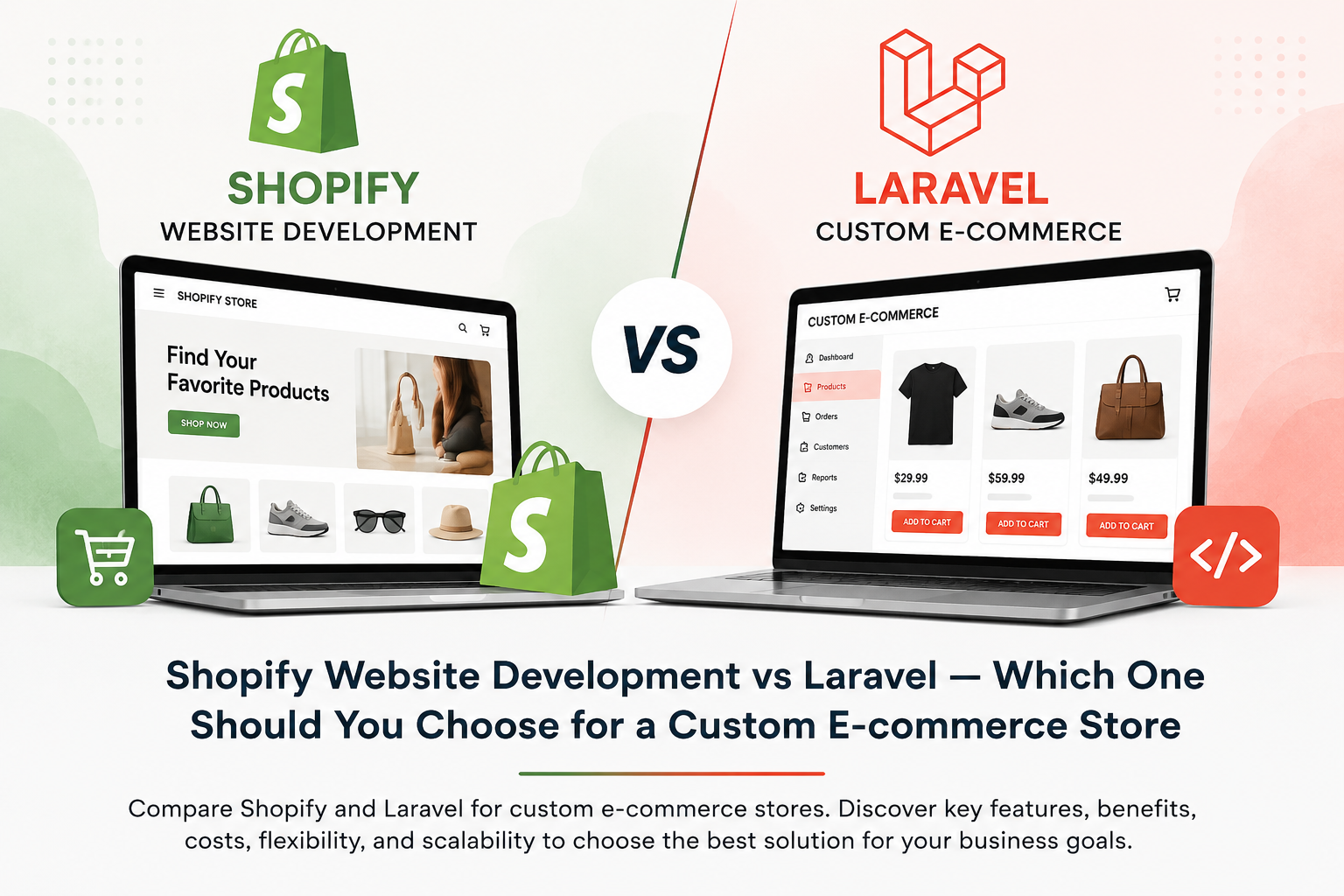
Businesses upgrading their online operations eventually hit a frustrating wall. They have to decide between renting a managed infrastructure or building one from scratch. You look at Shopify and see speed. You look at Laravel and see absolute control.
The choice dictates your budget, your hiring strategy, and how fast you can respond to market changes. There is no universally correct platform. There is only the right platform for your specific business logic.
The Infrastructure Gap: Working with a Shopify Website Development Company vs Laravel Engineers
Shopify is a fully hosted, closed-source commerce product. You pay a subscription, and they manage the servers, the database, and the checkout security. It provides a tested, conversion-optimized environment out of the box.
Laravel is an open-source PHP framework. It gives developers the tools to write a custom application. It is not an out-of-the-box store. Choosing Laravel means you are building a software product from the ground up. You configure the database. You manage the routing. You build the admin panel.
If you want to sell products immediately without managing servers, Shopify wins. A specialized Shopify website development company can configure your catalog, build your theme, and get you live in weeks. If your business model involves complex B2B pricing matrices, highly specific database relationships, or massive multi-tenant setups, Laravel becomes necessary.
The True Cost of Building and Maintaining Your Store
Upfront costs deceive people. A custom Laravel build requires heavy initial investment. You pay for user interface design, database architecture, third-party API integrations, and server setup. Maintenance is constant. When a payment gateway updates its API, your development team has to rewrite the integration. You are fully responsible for security patches and server costs.
Shopify flips this model. The initial barrier to entry is low. Security patches happen quietly in the background. But as you scale, the cost shifts to the app ecosystem. Advanced search, loyalty programs, and complex shipping rules require third-party apps. A mid-market store often spends hundreds of dollars a month just on these app subscriptions. Each app adds code to your site, which can impact page speed.
Working with a competent Shopify website development company in India helps mitigate this. Instead of relying on bloated third-party apps for basic functionality, experienced developers can hardcode specific features directly into your theme. You get the stability of Shopify without the heavy monthly app tax.
Why Speed to Market Demands a Shopify Website Development Company
Engineering time is expensive. On a custom Laravel build, every new feature goes into a development sprint. A marketing team wanting to add a new promotional banner or change a product bundling strategy might have to wait two weeks for the next deployment cycle. Every change requires an engineer.
Shopify removes the developer bottleneck for daily operations. Marketers can adjust collections, modify landing pages, and launch discounts independently. The dashboard is built for retail operators, not software engineers.
When you hire a Shopify e-commerce website development company, the focus shifts from building basic infrastructure to conversion rate optimization. Your budget goes toward designing a better user experience rather than paying someone to reinvent shopping cart logic. This operational independence gives growing brands a serious advantage. They react to the market instantly.
How a Shopify Website Development Company Navigates Checkout Constraints
Shopify restricts modifications to the actual checkout page unless you upgrade to the enterprise-level Shopify Plus. This protects their PCI compliance and ensures the checkout remains secure. For most retail brands, the standard checkout converts perfectly fine.
If you need a highly specialized delivery date picker or multi-vendor split payments directly at checkout, you hit a hard limit on standard Shopify plans. Laravel has no such limits. You own the code. You build whatever checkout experience your developers can execute. A skilled developer can guide you on whether your checkout requirements justify the massive expense of a custom Laravel build or if a workaround exists within the Shopify ecosystem.
Handling High-Traffic Events and Scalability
Traffic spikes expose weak architecture. During a major holiday sale event, a custom Laravel application requires active load balancing and database query optimization. If your server goes down under heavy traffic, your sales stop. Your IT team has to fix it immediately. You lose revenue for every minute of downtime.
Shopify handles the infrastructure for you. It processes billions of dollars during major sales events without downtime. You never configure a server or manage caching layers. The platform auto-scales to handle the load. Outsourcing server anxiety to a dedicated platform is the only logical choice for brands that experience massive, unpredictable traffic surges.
Making the Final Decision with a Shopify Development Agency
Choose Laravel when your store functions more like a custom software product. Maybe you run a complex B2B quoting system, or you route inventory across fifty micro-warehouses based on custom rules. When off-the-shelf apps start fighting your daily operations, you need dedicated engineers. You need direct database access.
Pick Shopify if your primary focus is retail growth rather than software maintenance. The technical constraints of Shopify are rarely the reason a standard ecommerce business fails. Most brands need a fast, secure, and reliable way to sell products.
We see companies waste months trying to build custom infrastructure when they should be focusing on customer acquisition. We prefer to channel that energy into sales and user experience. At OptMum Digital, we focus on building high-converting storefronts without the technical bloat. As a dedicated Shopify development agency, we guide brands through the ecosystem. We optimize your setup so you rely less on expensive apps and more on solid architecture. Reach out to us at OptMum Digital when you are ready to build a store that prioritizes revenue over unnecessary engineering complexity.
Frequently Asked Questions
How does SEO compare between the two?
Shopify handles the technical SEO baseline automatically. Things like mobile responsiveness, caching, and meta structures work out of the box. But if you have an aggressive strategy requiring highly specific URL routing, Shopify’s rigid nature will frustrate you. Laravel gives you total control over the architecture. You just have to build it yourself.
Can we migrate a custom Laravel store to Shopify?
You can move your data, but not the code. We routinely export customer records, order histories, and product catalogs from custom SQL databases and map them into Shopify. But your frontend design? You leave that behind. You have to rebuild the actual storefront using Shopify’s theme framework.
Who handles security and PCI compliance?
If you use Shopify, they do. You never have to worry about a missed server patch causing a data breach. With Laravel, that burden falls entirely on your IT team. You secure the database. You maintain the PCI compliance. If something breaks, it’s your problem.
What about transaction fees?
Laravel is open-source. You only pay your standard gateway processing rates, like Stripe or PayPal. Shopify penalizes you if you don’t use their native payment gateway. If you bring your own third-party processor to Shopify, expect an extra platform transaction fee on every sale.