
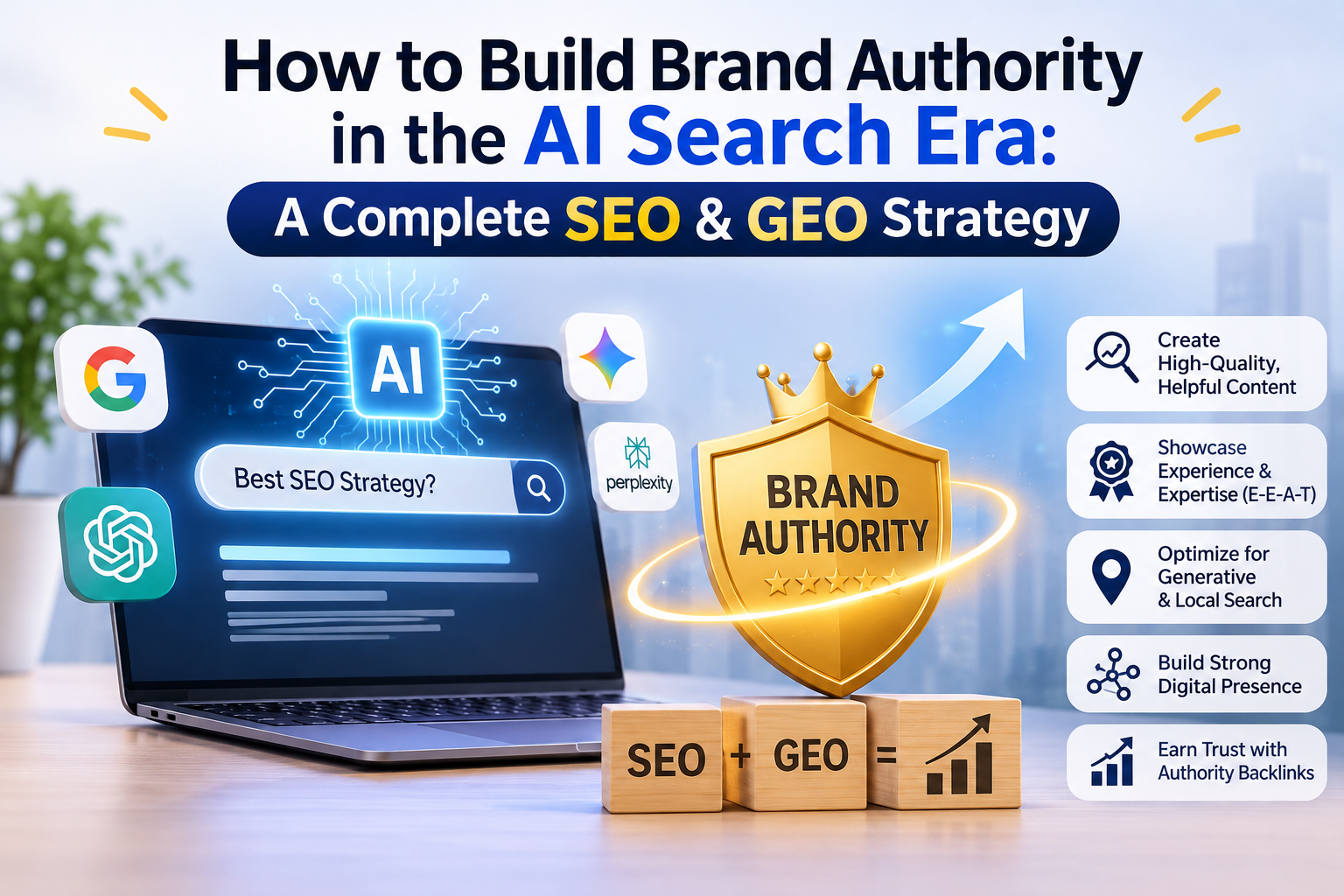
Ask a question on Google today and you may get an AI-written answer before you see a single link. Under the hood, AI Mode and AI Overviews use the same ranking and quality systems as regular Search, and we plan every project around that. Brand authority in AI search still comes down to being useful and showing real expertise. This guide covers where generative engine optimization (GEO) fits and which habits you can drop. It ends with a plan your team can start this quarter.
What Authority Looks Like in AI Search
AI answers draw on the existing search index, and they also pick up what the rest of the web says about you. That can be a blog post, a video or a forum thread where someone recommends your company. So your reputation lives on your own pages and, just as much, in other people’s conversations. Strong brand authority SEO covers both. Publish things other people want to cite, and the mentions tend to follow. Asking for them rarely works.
Good SEO Is Still Good GEO
People keep coming up with new labels for this work, like GEO and AEO. We treat them all as plain SEO. Generative engine optimization (GEO) is useful shorthand, and that is all it is. AI search also runs a fan-out technique that pulls in a wider mix of helpful links, so a page that covers its topic properly gets more chances to show up.
Your existing SEO work still counts, so start there. Audit the site before you add anything new. Expect to find pages that never got indexed, a few thin ones and statistics that went out of date a year ago. That cleanup is where AI search optimization usually pays off first.
Write for People, Not Bots
Several popular tactics waste time, and we steer clients away from them. You do not need to chunk content into tiny artificial snippets or write awkward, keyword-heavy copy. Chasing inauthentic mentions on other sites does not help either. And for Google Search, special files such as LLMs.txt are not needed.
Search systems understand language much like a person does, so clear, natural writing is what gets rewarded. Every hour you stop spending on those tasks can go back to the people reading your pages.
Publish Content Only Your Brand Can Write
Generic content is the easiest thing to replace. Here is an example we like. A local running store could film a deep dive on why one customer’s shoe collapsed, instead of publishing another “Top 10 Things to Consider” article. That video answers a specific problem with advice nobody else could have written.
Apply the same idea to your business. A marketing agency might break down why a client’s campaign stalled and what fixed it. A clinic could have its own doctors explain a procedure in plain terms. First-hand stories, named experts and original data make up what we call noncommodity content, and it gives you a lasting edge.
If you sell products or serve a local area, keep your Merchant Center feeds and Google Business Profile current. Both help your listings appear in generative AI responses and in standard results.
Make Your Website Worth the Click
Visitors arriving from AI surfaces are often better informed and closer to a decision. A slow or cluttered page wastes that moment. Check that the site displays well on every device, loads quickly and makes the main content easy to spot. Relevant images and videos can also earn richer placement in results. Treat page experience as part of AI search visibility, because a click only counts if the visit goes well.
Measure Goals, Not Noise
New dashboards promise answers about AI performance, but third-party SEO tools cannot see Google’s internal metrics, so treat their scores as rough estimates. Anchor your reporting to leads, sales and sign-ups instead, since business goals remain the clearest signal of how you are really performing.
For AI-specific data, Search Console has begun rolling out performance reports that show impressions from AI features on Google Search. Retailers can also use Merchant Center reporting to see how product listings appear. Treat these as a baseline for checking whether your content and technical work is paying off.
A Simple Authority Plan
Brand authority SEO comes down to steady habits rather than one big campaign. Here is the order of work we follow with clients, since each step builds on the one before:
- Start with an audit of your indexed pages, and fix technical gaps first.
- Five topics where your team has hands-on experience deserve deep, detailed pages.
- Name the experts behind each page, with their credentials and real examples.
- Video or original images belong wherever they explain something faster than text.
- Business Profile details and product feeds need to stay accurate.
- Every month, compare leads and conversions with the AI impressions in Search Console.
FAQs
Do I need a separate strategy for AI search?
Not really. AI features rest on the core ranking systems, so a solid SEO base carries over. The AI search optimization work that remains is mostly about sharper, more original content.
Should I add an LLMs.txt file?
Google Search does not need one. Your time is better spent on content and site quality.
How do I know if it is working?
Compare your lead and sales numbers with the impressions reported in Search Console’s new AI performance reports. If both climb together, the strategy is doing its job.
Build Authority That Lasts
Brand authority in AI search is earned the slow way: by being relentlessly helpful, showing real expertise and giving visitors a good experience. The tactics will keep getting new names, but the foundation stays put. At OptMum Digital, we help businesses audit their sites, shape original content and track AI search visibility against revenue. Talk to our team, and we will map out a plan that fits your goals.